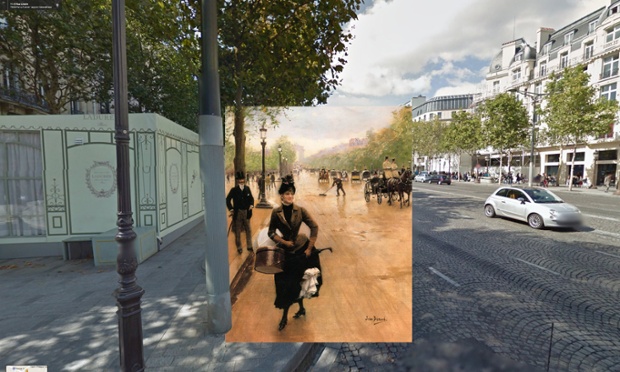
Classic paintings of world cities meet Google Street View – in pictures | Cities | theguardian.com:
Something I have wondered about for a long time--overlaying an artist's vision on the top of a photographic image. It is interesting how well some of the images work, but one wonders all the same about the accuracy of the perspective or the location of the viewer (artist or camera).
But the point of view that we have now is the automobile's view from the street. And one realizes how much has been lost with the taking over of cities with cars.
'via Blog this'
written longhand
06 March 2014
10 March 2013
Christopher Woodward on the genius of Joseph Gandy | Art and design | The Guardian
Christopher Woodward on the genius of Joseph Gandy | Art and design | The Guardian:
Joseph Gandy's dream:
'via Blog this'
Joseph Gandy's dream:
"In his dream he was standing on a staircase, watching a man sweet talk a girl at a window. Gandy was in love with the girl. Suddenly, a stranger took his arm. You must take her by force, he whispered; I am your friend, and will show you how. The man took him to palaces and dinners, and gave him presents. You are the Devil, Gandy exclaimed. He was seized, and woke in Hell. It was a city manufacturing luxuries in glass and gold, where "heavy cranes ... lift Foreign Goods from Ships". Hell was modern London."
'via Blog this'
12 February 2013
Why don’t Americans walk more? The crisis of pedestrianism. - Slate Magazine
Why don’t Americans walk more? The crisis of pedestrianism. - Slate Magazine:
'via Blog this'
"The writer Will Self, a dedicated walker, well captured the sense that the pedestrian life is one so removed from daily consciousness that to participate in it implies some higher purpose. “Whenever I tell people I’m going to walk somewhere utilitarian—like an airport; or even a long distance walk that seems quite prosaic to me, they always ask: ‘Is it for charity?’ ”"
'via Blog this'
28 January 2013
Reflecting the Past: Technology brings the ghosts of the past back to life (Wired UK)
Reflecting the Past: Technology brings the ghosts of the past back to life (Wired UK):
'via Blog this'
"We're trying to work out whether places have memories and if so, how can we help people relate to these memories," says Tim Cole, a lecturer in History at the University of Bristol.Psychogeography project reported by Wired UK
'via Blog this'
13 January 2013
Why Google's Ingress game is a data gold mine - tech - 29 November 2012 - New Scientist
Why Google's Ingress game is a data gold mine - tech - 29 November 2012 - New Scientist:
'via Blog this'
"Virtual guide points out the sights
You can't beat having a local show you around their city, one who knows exactly where you are and points out fascinating details about your surroundings. Now a new smartphone app from Google called Field Trip aims to do just that. The app, only available on Android phones in the US for now, uses Wi-Fi or GPS to place you, then feeds you relevant information about your location, alerting you to interesting places as you pass near them.
The user decides how much or how little info they want, and alerts range from historical facts about buildings to reviews of restaurants and local money-off deals. For those behind the wheel, a driving mode announces details aloud."
'via Blog this'
Why Google's Ingress game is a data gold mine - tech - 29 November 2012 - New Scientist
Why Google's Ingress game is a data gold mine - tech - 29 November 2012 - New Scientist:
'via Blog this'
""This is classic Google," says Blair MacIntyre, director of the Augmented Environments Lab at Georgia Tech, Atlanta. "They may get information about new monuments, and that actually helps them generate more interesting search results, because these are the things that local people say are interesting.""
'via Blog this'
06 January 2013
Looking at the Battle of Gettysburg Through Robert E. Lee’s Eyes | History & Archaeology | Smithsonian Magazine
Looking at the Battle of Gettysburg Through Robert E. Lee’s Eyes | History & Archaeology | Smithsonian Magazine:
'via Blog this'
"“The technology is just a tool, and what really matters is how you use it,” she says. “Historical geography means putting place at the center of history. No supercomputers are required.” When I asked about her math and computing skills, she replied: “I add, subtract, multiply, divide.”"
'via Blog this'
08 October 2012
Philip Hensher: Why handwriting matters | Books | The Observer
Philip Hensher: Why handwriting matters | Books | The Observer:
I still think my handwriting is important, even if I do it rarely. The computer is so much more the tool used to create messages--emails--and to create lecture notes or other documents. Writing with a pen is so much more time-consuming--it is too slow for the pace os life, for the demands of information production or communication that press on us today. But, I still do write with pens and pencils although my handwriting has become worse--less legible, less personal--from lack of practice. I make plans, clean my fountain pen, buy ink, but I always put off until tomorrow the time when I will fill the pen and use it again. I know that the time of using fountain pens has gone, and I cannot imagine ever using a fountain pen again as I did in my twenties--every day, for hours on end.
"Those other writing apparatuses, mobile phones, occupy a little bit more of the same psychological space as the pen. Ten years ago, people kept their mobile phone in their pockets. Now, they hold them permanently in their hand like a small angry animal, gazing crossly into our faces, in apparent need of constant placation. Clearly, people do regard their mobile phones as, in some degree, an extension of themselves. And yet we have not evolved any of those small, pleasurable pieces of behaviour towards them that seem so ordinary in the case of our pens. If you saw someone sucking one while they thought of the next phrase to text, you would think them dangerously insane."
'via Blog this'
I still think my handwriting is important, even if I do it rarely. The computer is so much more the tool used to create messages--emails--and to create lecture notes or other documents. Writing with a pen is so much more time-consuming--it is too slow for the pace os life, for the demands of information production or communication that press on us today. But, I still do write with pens and pencils although my handwriting has become worse--less legible, less personal--from lack of practice. I make plans, clean my fountain pen, buy ink, but I always put off until tomorrow the time when I will fill the pen and use it again. I know that the time of using fountain pens has gone, and I cannot imagine ever using a fountain pen again as I did in my twenties--every day, for hours on end.
Subscribe to:
Posts (Atom)

