06 March 2014
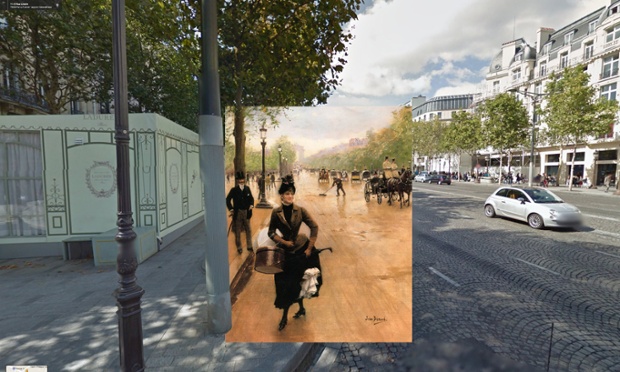
Classic paintings of world cities meet Google Street View – in pictures | Cities | theguardian.com
Something I have wondered about for a long time--overlaying an artist's vision on the top of a photographic image. It is interesting how well some of the images work, but one wonders all the same about the accuracy of the perspective or the location of the viewer (artist or camera).
But the point of view that we have now is the automobile's view from the street. And one realizes how much has been lost with the taking over of cities with cars.
'via Blog this'
10 March 2013
Christopher Woodward on the genius of Joseph Gandy | Art and design | The Guardian
Joseph Gandy's dream:
"In his dream he was standing on a staircase, watching a man sweet talk a girl at a window. Gandy was in love with the girl. Suddenly, a stranger took his arm. You must take her by force, he whispered; I am your friend, and will show you how. The man took him to palaces and dinners, and gave him presents. You are the Devil, Gandy exclaimed. He was seized, and woke in Hell. It was a city manufacturing luxuries in glass and gold, where "heavy cranes ... lift Foreign Goods from Ships". Hell was modern London."
'via Blog this'
12 February 2013
Why don’t Americans walk more? The crisis of pedestrianism. - Slate Magazine
"The writer Will Self, a dedicated walker, well captured the sense that the pedestrian life is one so removed from daily consciousness that to participate in it implies some higher purpose. “Whenever I tell people I’m going to walk somewhere utilitarian—like an airport; or even a long distance walk that seems quite prosaic to me, they always ask: ‘Is it for charity?’ ”"
'via Blog this'
28 January 2013
Reflecting the Past: Technology brings the ghosts of the past back to life (Wired UK)
"We're trying to work out whether places have memories and if so, how can we help people relate to these memories," says Tim Cole, a lecturer in History at the University of Bristol.Psychogeography project reported by Wired UK
'via Blog this'
13 January 2013
Why Google's Ingress game is a data gold mine - tech - 29 November 2012 - New Scientist
"Virtual guide points out the sights
You can't beat having a local show you around their city, one who knows exactly where you are and points out fascinating details about your surroundings. Now a new smartphone app from Google called Field Trip aims to do just that. The app, only available on Android phones in the US for now, uses Wi-Fi or GPS to place you, then feeds you relevant information about your location, alerting you to interesting places as you pass near them.
The user decides how much or how little info they want, and alerts range from historical facts about buildings to reviews of restaurants and local money-off deals. For those behind the wheel, a driving mode announces details aloud."
'via Blog this'
Why Google's Ingress game is a data gold mine - tech - 29 November 2012 - New Scientist
""This is classic Google," says Blair MacIntyre, director of the Augmented Environments Lab at Georgia Tech, Atlanta. "They may get information about new monuments, and that actually helps them generate more interesting search results, because these are the things that local people say are interesting.""
'via Blog this'
06 January 2013
Looking at the Battle of Gettysburg Through Robert E. Lee’s Eyes | History & Archaeology | Smithsonian Magazine
"“The technology is just a tool, and what really matters is how you use it,” she says. “Historical geography means putting place at the center of history. No supercomputers are required.” When I asked about her math and computing skills, she replied: “I add, subtract, multiply, divide.”"
'via Blog this'
08 October 2012
Philip Hensher: Why handwriting matters | Books | The Observer
"Those other writing apparatuses, mobile phones, occupy a little bit more of the same psychological space as the pen. Ten years ago, people kept their mobile phone in their pockets. Now, they hold them permanently in their hand like a small angry animal, gazing crossly into our faces, in apparent need of constant placation. Clearly, people do regard their mobile phones as, in some degree, an extension of themselves. And yet we have not evolved any of those small, pleasurable pieces of behaviour towards them that seem so ordinary in the case of our pens. If you saw someone sucking one while they thought of the next phrase to text, you would think them dangerously insane."
'via Blog this'
I still think my handwriting is important, even if I do it rarely. The computer is so much more the tool used to create messages--emails--and to create lecture notes or other documents. Writing with a pen is so much more time-consuming--it is too slow for the pace os life, for the demands of information production or communication that press on us today. But, I still do write with pens and pencils although my handwriting has become worse--less legible, less personal--from lack of practice. I make plans, clean my fountain pen, buy ink, but I always put off until tomorrow the time when I will fill the pen and use it again. I know that the time of using fountain pens has gone, and I cannot imagine ever using a fountain pen again as I did in my twenties--every day, for hours on end.
09 February 2012
Something similar has happened to the Internet. Transcending its original playful identity, it’s no longer a place for strolling — it’s a place for getting things done. Hardly anyone “surfs” the Web anymore. The popularity of the “app paradigm,” whereby dedicated mobile and tablet applications help us accomplish what we want without ever opening the browser or visiting the rest of the Internet, has made cyberflânerie less likely. That so much of today’s online activity revolves around shopping — for virtual presents, for virtual pets, for virtual presents for virtual pets — hasn’t helped either. Strolling through Groupon isn’t as much fun as strolling through an arcade, online or off.
20 October 2011
The Typewriter (In the 21st Century)
It would be nice--in a way--to believe that the typewriter has a future, but, heck, I am beginning to wonder if the ballpoint pen has a future. But, if I lived in a place where I could take my Underwood Standard in to a repair shop and get it working again, I probably would. And, then...
06 September 2011
William Gibson Interview
William Gibson interview: Boing Boing exclusive – Boing Boing
What things are keeping your interest lately? The sheer surreality of the Republican presidential primary, Libya, Iain Sinclair's monolithic ongoing anti-Olympics project (Hackney, That Rose Red Empire and now Ghost Milk), the "gray man" concept in personal security, the culture of personal aerial drones, parts of the United States as newly undeveloped sub-nations and the foreign outsourcing thereof...
29 June 2011
Teaching Writing
First day of class I used to tell students that I could not teach them to be observant, to love language, to acquire a sense of drama, to be critical of their own work, or almost anything else of significance that comprises the dear little demanding art of putting proper words in their proper places. I didn’t bring it up, lest I discourage them completely, but I certainly could not help them to gain either character or an interesting point of view. All I could do, really, was point out their mistakes, and, as someone who had read much more than they, show them several possibilities about deploying words into sentences, and sentences into paragraphs, of which they might have been not have been aware. Hence the Zenish koan with which I began: writing cannot be taught, but it can be learned.
23 June 2011
18 June 2011
a theory of university: one of two answers
I could have answered the question in a different way. I could have said, “You’re reading these books because they teach you things about the world and yourself that, if you do not learn them in college, you are unlikely to learn anywhere else.” This reflects a different theory of college, a theory that runs like this: In a society that encourages its members to pursue the career paths that promise the greatest personal or financial rewards, people will, given a choice, learn only what they need to know for success. They will have no incentive to acquire the knowledge and skills important for life as an informed citizen, or as a reflective and culturally literate human being. College exposes future citizens to material that enlightens and empowers them, whatever careers they end up choosing.
The theory of university as a sort of indoctrination, and the encounters that students have with knowledge is planned around a number of challenging situations or topics or ideas. Frye said that all learning involves overcoming personal barriers, and this idea of education is about this type of barrier-encountering. The point is that it will not be pleasant or fun--at least some of the time--some of the time it will be exactly what the student does not want. Other times it will be exciting and even blissful.
29 May 2011
The end of the typewriter
News has come in recently that Godrej and Boyce, a long-established firm of typewriter producers based in Mumbai, have a mere 500 manual typewriters left in stock. Once these have been sold, or disposed of, they will switch to making refrigerators instead. There is, apparently, a small demand still for electric typewriters in America, particularly in schools and prisons. One can understand why the latter could make use of them, since the time hasn't come for prisoners to access porn on a humble piece of office equipment. But these are clearly the last of a dying breed.
I have my old typewriter in my office, but should I keep it there, now just a museum piece?
Museums that contain objects of use from the past or that are in fact the houses of people that display the study of the person as it was left—with the typewriter, for example—show the way that such objects are meaningless unless they are used. They are like the kitchen wood stove without a fire in the stove. They are like the bowl and rolling pin without the live ingredients which bring the objects to life.
What one has is like the skeleton of the animal rather than the animal itself. And in this way photographs, for example, are better, so long as they contain the trace of the human. So the contemporary photograph of the writer’s typewriter is meaningless—it is just a picture of an old typewriter. But the photograph of the typewriter on the writer’s lap or with the writer’s hand or with a fresh piece of paper that will actually be typed on a few seconds after the photo is taken, this is alive in a different way.
10 May 2011
man of the crowd
Not long ago, about the closing in of an evening in autumn, I sat at the large bow window of the D -- -- Coffee House in London. For some months I had been ill in health, but was now convalescent, and, with returning strength, found myself in one of those happy moods which are so precisely the converse of ennui -- moods of the keenest appetency, when the film from the mental vision departs -- the _____ -- and the intellect, electrified, surpasses as greatly its everyday condition, as does the vivid yet candid reason of Leibnitz, the mad and flimsy rhetoric of Gorgias. Merely to breathe was enjoyment; and I derived positive pleasure even from many of the legitimate sources of pain. I felt a calm but inquisitive interest in everything. With a cigar in my mouth and a newspaper in my lap, I had been amusing myself for the greater part of the afternoon, now in poring over advertisements, now in observing the promiscuous company in the room, and now in peering through the smoky panes into the street.But, this is not London and the crowds passing are mostly cars in the rain.
Poe, Edgar Allan, 1809-1849. "The Man of the Crowd" Electronic Text Center, University of Virginia Library
26 April 2011
Book and other piracy -- research needed
Publishers need more research (and more nuanced research) about the impact of book piracy in order to have a more informed perspective on how to approach it.
People pirate for many reasons. Some do it simply for the love of pirating. Some people amass large collections of movies and music and books that they may never watch, listen to, or read. Others pirate because they feel they simply can't afford to pay. These types of pirates are probably the hardest to convert into paying customers.
24 April 2011
Novelty Seeking research
is one of four aspects that Dr. Cloninger and many other psychologists propose as the basic bricks of normal temperament, the other three being avoidance of harm, reward dependence and persistence. All four humors are thought to be attributable in good part to one's genetic makeup -- the predisposition that one is dealt at birth. They are the aspects of human nature that mark one person as a pessimistic worrywart, another as an outgoing team player.
Temperament remains fairly stable throughout life, Dr. Cloninger said, which means the shy and anxious boy is likely to be the shy and anxious grandfather, though psychiatric drugs, intense counseling or life-changing experiences can modify some aspects of temperament.
Any one person may have a mixture of varying degrees of the four temperamental dimensions. For example, a novelty seeker may have a low quotient of harm avoidance, not fretting over dangers real or imagined; a high level of persistence, and a high level of reward dependence, and so cares about making some sort of impact or statement.
Such an individual could serve as a poster person for achievement, the type with the self-confidence, optimism and originality to do something brilliant in life, assuming his or her great temperament was combined with great talent.
Alternatively, a novelty seeker who is low in reward dependence and low in harm avoidance may care little for friends or society and end up an aloof alcoholic.
17 April 2011
London in 1825
London 1825
Population: 1,335,000
While the British Empire was flung around the globe bringing in immense wealth for a small portion of England, London, was largely a slum in 1825.
And crime was rampant. Not until four years after the city reached the record for being the most populous in the world did government activate a full time police force.
Information relevant to the London De Quincey described in 1821, and Pierce Egan in Life in London.